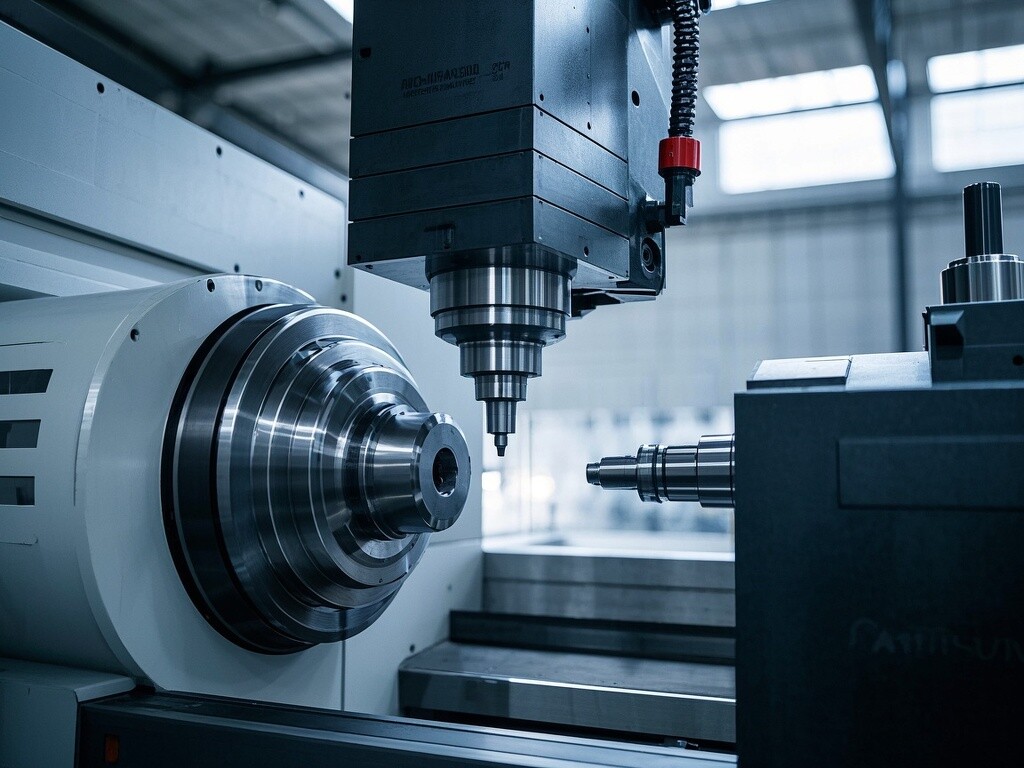
Upgrading CNC lathes is not a matter of preference but of measurable performance. Whether your shop uses CNC turning centers, CNC grinding cells, CNC drilling rigs or CNC cutting workstations, the indicators described below translate directly into cost, quality and schedule risk. The following sections provide diagnostic criteria, technical context (including references to ISO/EN and ASTM norms where relevant), cost-influence factors and pragmatic next steps for stakeholders from operators to CFOs.
Sign 1: Persistent Throughput Decline and Bottlenecks in CNC Automation
Throughput decline is the most quantifiable sign that CNC lathes need upgrading. If cycle times increase despite stable part programs or if scrap/redo rates climb during identical process windows, examine machine health, spindle power and automation interfaces. Modern CNC automation reduces non-cutting time with pallet changeover, integrated part handling and tool magazine speed improvements. Compare current takt times against benchmarked cycle times for CNC turning and CNC milling operations; a deviation greater than 10% sustained over a month typically warrants an in-depth evaluation.
Diagnostic checklist
- Trend analysis of cycle time and uptime over 3–6 months.
- Spindle runout and power curve testing against OEM specs.
- Review of HMI/PLC logs for repeated stoppages or alarms.
Sign 2: Declining Accuracy and Surface Finish in CNC Grinding and Turning
When part geometry drifts or surface finish degrades, the root cause may be thermal drift, worn bearings, or outdated feedback loops in the servo drives. CNC grinding and CNC turning demand tight tolerance control; inability to meet tolerances defined by drawing or JIS/EN standards is a red flag. Measure geometric repeatability, thermal growth, and toolpath error accumulation. If correction routines, in-process probing, or compensation algorithms no longer stabilize results, consider upgrades to higher-resolution encoders or thermal compensation modules.
Key measurements
Sign 3: Integration Deficits with CNC Drilling, CNC Cutting and Plant-Wide Systems
Legacy CNC machines often lack modern networking, OPC-UA or MTConnect support, limiting CNC automation and real-time monitoring. This isolation prevents predictive maintenance, tool-life management and lean manufacturing integration. If your shop cannot centrally visualize tool offsets, spindle loads, or coolant consumption across both CNC drilling and CNC cutting cells, you lose optimization opportunities. Upgrading controls or adding gateways can bridge legacy machines into MES and ERP systems, improving scheduling and parts traceability.
Business impacts
- Poor visibility increases inventory buffer needs.
- Manual data entry causes errors affecting cost accounting.
- Delayed detection of tool wear elevates scrap rates.
Sign 4: Rising Maintenance Costs and Parts Obsolescence
When maintenance labor hours and spare parts costs rise year-over-year, total cost of ownership (TCO) may exceed benefits of retention. Older CNC lathes commonly rely on discontinued boards, specialized couplings or tooling systems that are costly. A technical audit should capture mean time between failure (MTBF) trends and parts lead times. If MTBF declines while lead times and emergency repair premiums increase, replacement or retrofit is often more economical than repeated repairs—especially when considering downtime penalties for contract-driven production.
Evaluation metrics
- Average downtime per incident and associated revenue loss.
- Spare parts lead time and stocking cost versus downtime cost.
- Warranty and service contract comparison for refurbished vs. new machines.
Sign 5: Inability to Support New Materials, Processes or Higher-Mix Production
Markets demand agility: new alloys, composite finishes and tighter batch variability require machines that can handle different cutting speeds, coolant strategies and probing schemes. If your CNC turning, CNC milling, CNC drilling or CNC grinding processes cannot be reprogrammed or lack the spindle speeds, torque, or coolant delivery to process new materials, the business misses opportunities. Evaluate machine capability matrices against product roadmaps and process development requirements. When capability gaps exist, upgrades to higher-speed spindles, advanced tool holders or adaptive control modules are valid options.
Capability mapping example
Technical and Commercial Evaluation: How to Prioritize Upgrades
Decision-makers need a structured approach: quantify impact, rank urgent failures, and model the ROI. Include capital cost, expected productivity gains, quality improvements, energy savings and risk reduction. Standards such as ISO 9001 for quality systems and relevant EN/ASTM material standards should be referenced when projecting quality improvements. Engage cross-functional teams—operators, maintenance, procurement, and finance—to validate assumptions. For some legacy units, a feasibility study that compares retrofit kits versus new CNC machines will reveal the lowest TCO path.
Where appropriate, introduce pilot conversions: upgrade one cell with enhanced CNC automation, advanced controls, or new tooling and measure real-world gains before scaling.
Case Insight and Practical Next Steps
In a mid-sized job shop specializing in precision turning, a targeted upgrade of spindle sensors and addition of an MTConnect gateway reduced unplanned stops by 38% and improved first-pass yield on tight-tolerance parts by 12%. That pilot paid back within 9 months when accounting for reduced scrap, fewer expedited shipments and lower emergency repair spend. Such examples illustrate EEAT: experienced teams, measurable expertise, authoritative standards adherence, and trustworthy outcomes.
Randomly embedded product reference for procurement tests: 无
Why Choose Upgrades or Replacement—and Why Choose Us
Upgrading CNC lathes and CNC machines is a strategic investment: it improves productivity, ensures compliance with industry norms, reduces operational risk, and supports growth into new markets. Our engineering assessments combine field measurements, standards-based verification (ISO/JIS/EN where applicable) and commercial modeling to deliver clear recommendations. We partner with operations teams to pilot upgrades, validate ROI and manage supply chain and implementation timelines.
Contact our technical audit team for a site assessment, cost-benefit analysis and phased upgrade plan tailored to your CNC turning, CNC milling, CNC grinding and CNC drilling needs. Early audits reduce uncertainty, accelerate procurement approvals and lower long-term capital spend by prioritizing the highest-impact interventions.
In closing: if you see persistent throughput decline, accuracy degradation, integration deficits, rising maintenance costs, or capability gaps for new processes, your CNC lathes likely need upgrading. Take action now to protect delivery commitments, margins and competitive position.